
The U.S. Army Won Battles in World War II with Inflatable Tanks, Sound Effects, and Artists
Imagine being told your military assignment for your first mission was to paint an entire city on top of a building. It sounds absurd, but during World War II, artists and designers were recruited by Uncle Sam to create elaborate camouflage schemes that hid military installations from enemy aircraft. The idea behind the Ghost Army was simple: make the enemy see something that was never really there. If artists could disguise a building, perhaps they could disguise an entire army.
Now imagine taking that idea and applying it to an entire army.
In 1944, German reconnaissance reports showed tanks gathering near the front. Radio transmissions suggested an armored division was preparing to move. Local civilians swore American soldiers were everywhere. At night, engines rumbled, troops shouted commands, and equipment seemed to be moving into position. Everything pointed to a massive Allied buildup.
But here’s the secret… much of what they were seeing and hearing didn’t actually exist.
Holy Hiccup! The American military has just pulled off one of the greatest tricks of World War II.
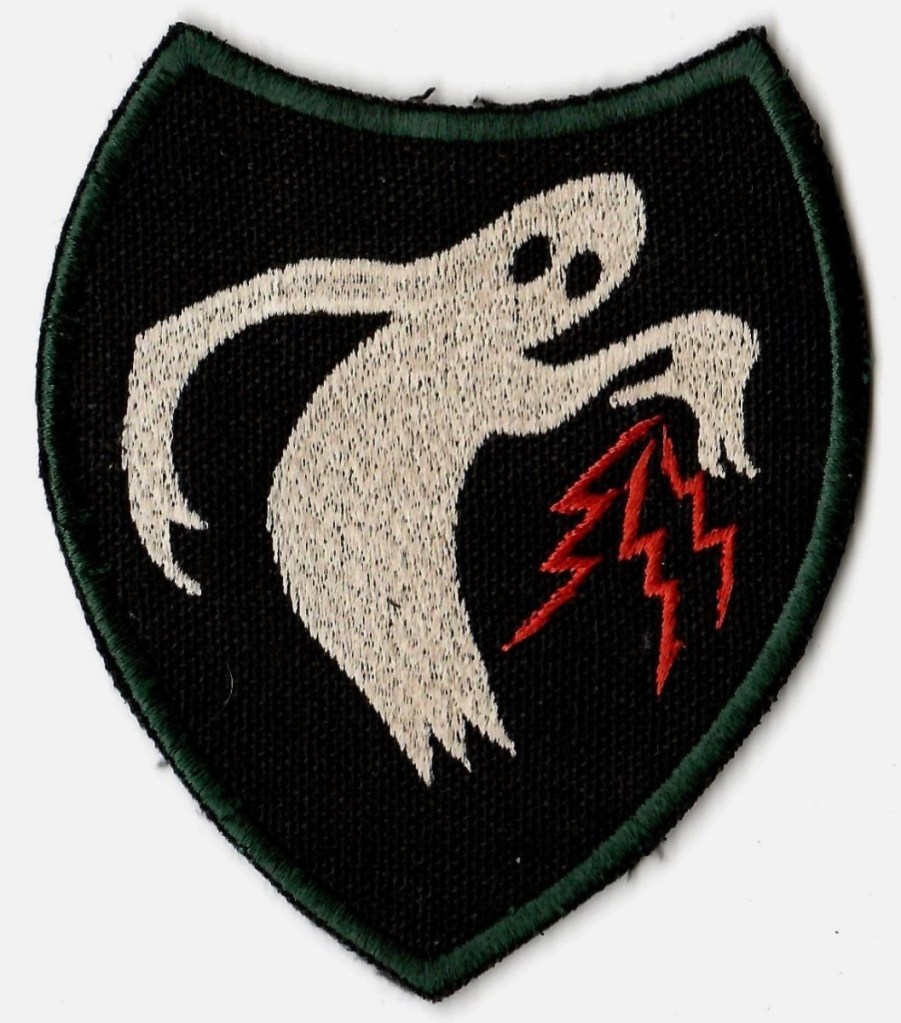
During the war, the United States created one of the most unusual military units in history: the 23rd Headquarters Special Troops, better known as the Ghost Army. Their mission wasn’t to destroy the enemy. Their mission was to fool them. And as it turned out, they were remarkably good at it.
Not Your Typical Soldiers
When most people think of World War II soldiers, they picture infantrymen slogging through mud, tank crews charging across battlefields, or pilots dogfighting high above Europe. The Ghost Army looked very different. Among its ranks were artists, illustrators, fashion designers, photographers, architects, and exhibition designers. One member, Bill Blass, would later become one of America’s most celebrated fashion designers, while others went on to distinguished careers in art, photography, and design. The Army was not looking for muscle as much as imagination. As Captain Fred Fox famously remarked, they were going to become a “traveling show” built on impersonations and imitations. In many ways, that was exactly what they became. Armed with creativity, ingenuity, and a flair for performance, these unlikely soldiers transformed deception into one of the Allied military’s most effective weapons.
Their Secret Weapon? Rubber.
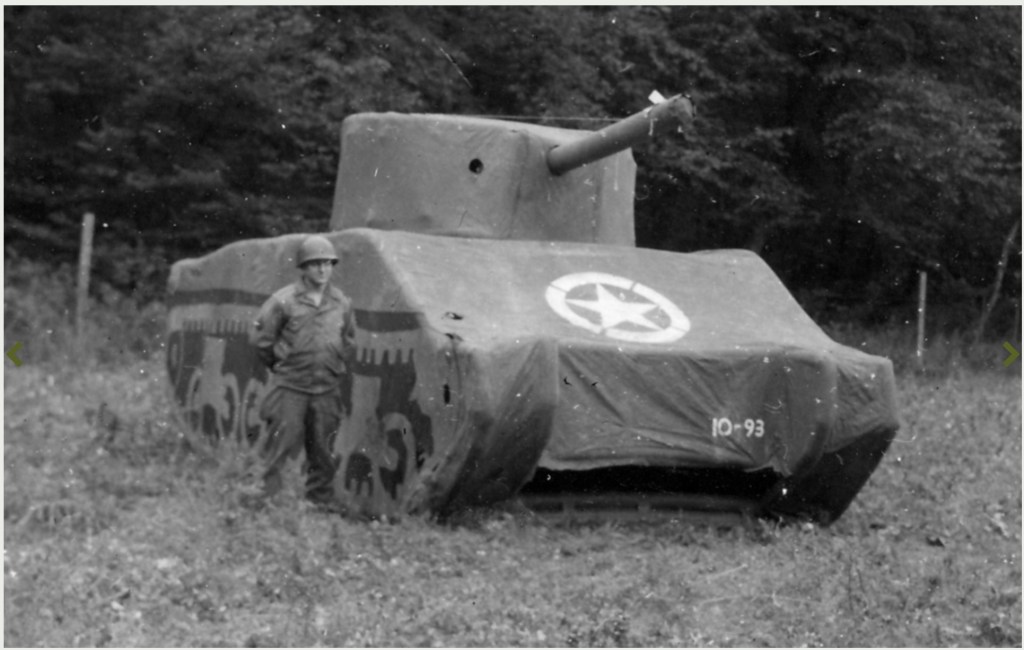
When new recruits arrived for training, they found warehouses packed with inflatable tanks, artillery pieces, trucks, and airplanes. Hundreds of them. The men quickly learned how to inflate, position, move, and camouflage these decoys to deceive enemy reconnaissance aircraft. Imagine spending your afternoon blowing up an entire armored division with an air compressor. It sounds absurd, and more than a little comical. Yet those rubber tanks would become some of the most effective weapons in the Ghost Army’s arsenal, repeatedly fooling German intelligence and helping to save thousands of Allied lives. Sometimes, the difference between victory and defeat was nothing more than a well-placed inflatable tank.
The Airwaves Were a Weapon Too
The Ghost Army didn’t rely on inflatable tanks alone. Their radio operators became masters of what they called “spoof radio,” a highly specialized form of deception designed to fool German intelligence. Because the Germans constantly monitored Allied radio traffic, Ghost Army operators carefully studied the habits, speech patterns, nicknames, and communication styles of real radio operators. When an actual combat unit moved to a new location and went silent, the Ghost Army seamlessly took over its radio identity. To German intelligence, it sounded as though the unit had never left. In many ways, they were method actors armed not with scripts and costumes, but with radios and Morse code.
The Art of Sonic Deception
Then there was the sonic deception unit. If Hollywood had existed on the battlefield, these men would have been running the sound department. Using advanced recording equipment and massive loudspeakers mounted on half-tracks, they blasted the sounds of moving tanks, marching troops, construction crews, and military convoys across the countryside. The recordings could carry for miles and convinced German forces that large formations were on the move. Need the enemy to believe an armored division was arriving? You play the sound of tank columns rumbling down a road. Need them to think engineers were constructing a bridge across a river? There was a recording for that, too. By mixing sounds together much like a modern movie soundtrack, the unit created remarkably convincing audio illusions. The only difference was that their audience wasn’t sitting in a theater, it was the German Army.
Selling the Performance
The Ghost Army understood something important: successful deception was not simply about what people saw, but what they believed. To make their illusions convincing, soldiers drove through towns in trucks adorned with the insignia of the units they were impersonating, visited local cafés, and casually discussed fictitious troop movements where enemy spies might be listening. They erected signs directing traffic to military units that did not exist, maintained campfires for soldiers who were never there, and sometimes even positioned fake equipment where it could be spotted by enemy aircraft. Every detail was carefully designed to reinforce the illusion. The goal was never perfection; it was believability. If the Germans believed an armored division was present, then the Ghost Army had done its job.
Fooling the Germans Over and Over Again
Between Normandy and the end of World War II, the Ghost Army carried out more than twenty deception operations, but two stand out as masterpieces of military trickery. During Operation Bettembourg, they convinced German forces that a powerful American armored division occupied a vulnerable sector of the line when, in reality, the force barely existed. The deception held for nearly a week, preventing the Germans from exploiting a dangerous gap in Allied defenses. Later, during Operation Viersen, the Ghost Army staged its most ambitious performance. Although the unit numbered only about 1,100 men, they successfully convinced the Germans that roughly 30,000 Allied troops were preparing for a major crossing of the Rhine River. To sell the illusion, they deployed more than 200 inflatable tanks, dummy artillery pieces, fake trucks, fabricated radio networks, simulated bridge construction, continuous sound effects, and even a dummy airfield. It was the military equivalent of the largest stage production in Europe, and the deception successfully diverted German attention from the actual crossing site, helping pave the way for a successful Allied advance into Germany.
The Best-Guarded Secret of the War
After World War II ended, the members of the Ghost Army returned home and said nothing. For decades, their missions remained classified, and many veterans were instructed not to tell friends, family members, or even their wives what they had done during the war. To the public, the Ghost Army was little more than a figment of the imagination, a unit that seemed too extraordinary to have ever existed. Then, in the 1990s, the full story began to emerge. Americans finally began to learn about the remarkable outfit that had weaponized creativity, revealing one of the war’s most ingenious and unconventional fighting units.
Why the Ghost Army Matters
The Ghost Army proves that not every hero of World War II carried a rifle or drove a tank. Sometimes they carried a paintbrush and relied on their imagination. Artists painted illusions, radio operators impersonated entire divisions, and sound technicians convinced the enemy that armies existed where none could be found. Through creativity, deception, and a healthy dose of theatrical flair, these men helped to save thousands of lives and played a critical role in Allied success. For a unit best known for inflatable tanks and elaborate tricks, the Ghost Army left an indelible mark on history.
Bibliography
Beyer, Rick. “Freddy Fox Goes To War”. Princeton Alumni Weekly, Last modified 2012. https://paw.princeton.edu/article/freddy-fox-goes-war.
Beyer, Rick. The Ghost Army A Documentary Film. Film. United States: Plate of Peas Production, 2013.
Binkovitz, Leah. “When An Army of Artists Fooled Hitler”. Smithsonian Magazine, Last modified 2013. https://www.smithsonianmag.com/history/when-an-army-of-artists-fooled-hitler-71563360/.
Janeczko, Paul B. Secret Soldiers: How the U.S. Twenty-Third Special Troops Fooled The Nazis. Sommerville, MA: Candlewick Press, 2019.


Leave a Reply