In the rugged hills of northwest Alabama, far from the cotton plantations of the Black Belt, Winston County carved out a distinctive place in Civil War history. Poor soil and steep terrain meant few large slaveholders lived there. Most residents were yeoman farmers who saw little reason to dissolve the Union and much to lose from a war fought largely for the interests of slaveholding planters. When Alabama seceded in January 1861, Winston’s people pushed back through a celebrated meeting that gave the county its enduring nickname, and finally by sending hundreds of men into blue uniforms.[1] Among these men was my third great-grandfather, James Alexander Barton of Company L, 1st Alabama Cavalry of the Union army.
Winston County had been organized only a decade earlier, first as Hancock County in 1850 and renamed for Governor John A. Winston in 1855. In the 1860 presidential election most local voters backed Southern Democrat John C. Breckinridge, yet the county’s deeper loyalty was to the Union. When Alabama called a secession convention, Winston elected a 21-year-old schoolteacher named Christopher Columbus Sheats by a landslide (515-128).[2] In Montgomery, Sheats refused to sign the Ordinance of Secession after it passed (61-39). He was later expelled from the legislature and imprisoned for a time on charges of treason. His stand reflected the sentiment of many neighbors who believed secession was illegal and that the war would be fought for the interests of planters rather than hill-country farmers.
On or about July 4, 1861, several thousand Unionists from Winston and surrounding counties gathered at Looney’s Tavern near present-day Addison. They adopted three resolutions. The first praised Sheats. The second denied Alabama’s right to leave the Union but declared that if a state could secede, then a county could secede from the state. The third asked both the Confederacy and the Union simply to leave Winston alone so its people could “Work out our own political and financial destiny.” A Confederate sympathizer present, Richard Payne, reportedly scoffed, “Oho! Winston secedes! The Free State of Winston!” The mocking phrase stuck and became a badge of local identity.[3] Winston never formally left Alabama, and the state never recognized any such claim, but the meeting announced a clear preference for neutrality that soon hardened into active Unionism.
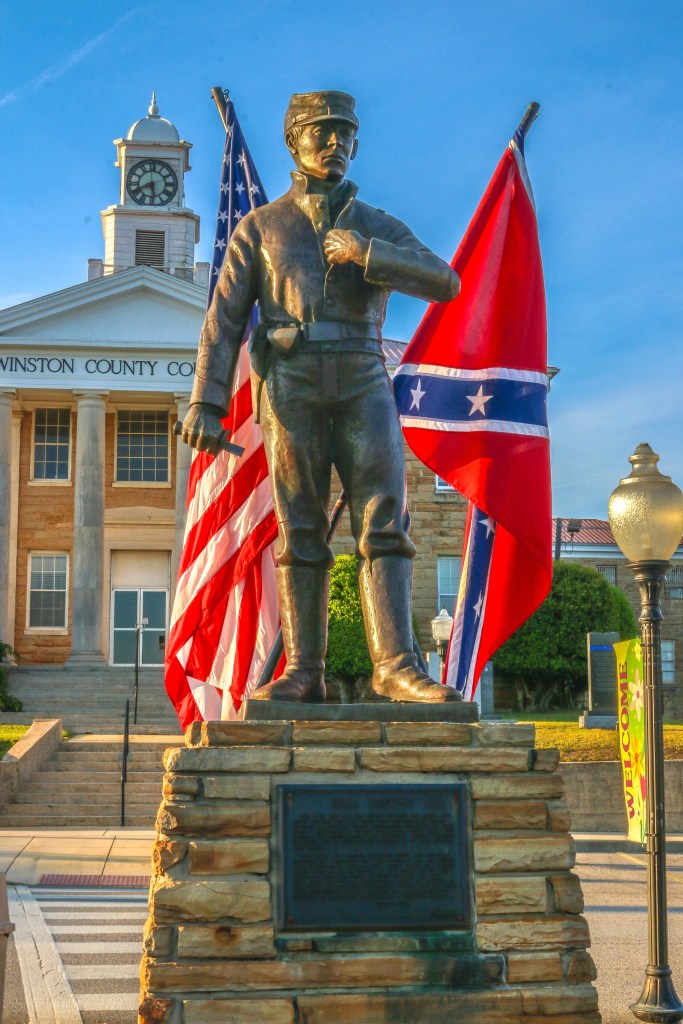
Today the “Free State of Winston” name lives on in tourism and local memory. A weathered barn between Haleyville and Double Springs still bears the painted slogan. In front of the courthouse in Double Springs stands the Dual Destiny monument, a soldier split down the middle, half Union blue and half Confederate gray, commemorating the county’s divided loyalties. These modern emblems are not Civil War-era seals or flags; they are later expressions of a history the county has chosen to claim rather than erase.
Neutrality proved impossible. Confederate conscription laws of 1862 sent agents into the hills. Many young men “laid out” in the forests and canyons. Natural Bridge became a known refuge for those not wanting to serve the Confederacy. Some were hunted, others threatened or had property seized. Gradually the neutral stance gave way to open resistance. Recruiters for the Union army found willing volunteers. Of the roughly 2,678 white Alabamians who enlisted in Federal service, more than 2,000 served in a single regiment: the 1st Alabama Cavalry, U.S. Volunteers, the only predominantly white Union regiment raised from Alabama.[4]
The regiment was organized in late 1862 at Corinth, Mississippi, and Huntsville, Alabama, under Colonel George E. Spencer. Its men performed scouting, raiding, and screening duties across Northern Mississippi and Alabama. During the Atlanta Campaign of 1864 they guarded wagon trains and railroads for General Grenville Dodge’s command. When William T. Sherman prepared his March to the Sea, he deliberately chose the 1st Alabama as escort. Company I served as Sherman’s personal escort; the regiment often rode at the head of the column. The symbolism was deliberate: Southerners in blue leading the Federal army through the heart of the Confederacy. The 1st Alabama stayed with Sherman through the Carolinas Campaign, fought at Monroe’s Crossroads, and was present at the surrender of Joseph E. Johnston’s army. It mustered out in October 1865 with fewer than 400 men still on the rolls.[5]
James Alexander Barton was one of those men. Born December 26, 1825, in Hall County, Georgia, he moved with his family into the northwest Alabama hill country. In September 1863 he and four brothers, Jonathan, Gilford, Madison, and William H., enlisted together in Company L at Glendale, Mississippi. Three brothers-in-law also joined the same company. James stood six feet one inch, with blue eyes, dark hair, and a fair complexion. He was a blacksmith by trade. On or about October 1863, at Vincent’s Cross Roads, Mississippi, he was wounded across the back of the right hand. The injury stiffened two fingers and permanently reduced his ability to work. After the war he received a disability pension and filed a successful claim with the Southern Claims Commission for wartime losses. He later moved to Itawamba County, Mississippi, where he died April 6, 1914, at the age of 88. His gravestone simply records, “Co. L, 1 Ala. Cav.”[6]
James’s story is typical of the regiment’s ranks: small farmers and craftsmen from the same tight-knit hill communities who chose the Union over neighbors, sometimes over blood kin. William H. Barton was captured and died at Andersonville.[7] The survivors returned to a country still marked by bitterness. Postwar violence between former Unionists and Confederates was real, yet Winston’s Unionist majority helped make the county a Republican stronghold for decades.
The Free State of Winston was never a formal republic with its own constitution or army. It was a declaration of independence of mind, an assertion that ordinary people in the hills retained the right to decide their own loyalty. The men who rode with the 1st Alabama Cavalry translated that declaration into action, escorting Sherman’s columns and helping to break the Confederacy’s grip on the Deep South. For descendants like me, the name James A. Barton on the regimental rolls is more than a genealogical footnote. It is a reminder that the Civil War in Alabama was never a simple story of solid South versus solid North. In Winston County the choice was made one farm, one tavern meeting, and one enlistment paper at a time.
[1] Christopher M. Reali, The Free State of Winston: Resistance, Refuge, and the Identity in the Civil War South (Macon, GA: Mercer University Press, 2014), 1-15.
[2] Reali, Free State of Winston, 22-30.
[3] Bill Lamar and Weldon Estes, Free State of Winston: The Republic of Winston and the Civil War (Double Springs, AL: Winston County Self-Historical Commission, rev. ed.), 25-39.
[4] Reali, Free State of Winston, 63-102.
[5] Joseph W. Overall, The 1st Alabama Cavalry, U.S.A.: Horsemen Against the Confederacy (Kent, OH: Kent State University Press, 1999), 15-43.
[6] Overall, 1st Alabama Cavalry, 105-147; Compiled Military Service Record, James A. Barton, Company L, 1stAlabama Cavalry (US), Fold3.
[7] Compiled Military Service Record, William H. Barton, Company L, 1st Alabama Cavalry (US), Fold3.


Leave a Reply