• On November 14, 1732, the Library Company of Philadelphia signed a contract with its first librarian. Benjamin Franklin and his associates had founded the institution the previous year. Its collections would later be made available to the Continental Congress in 1774. That single contractual moment marked the practical beginning of America’s first successful subscription library in British North America, an institution that would quietly influence the intellectual life of the colonies and, eventually, the founding of the United States itself.

    In the early eighteenth century, books were scarce and expensive in British North America. Most substantial libraries belonged to wealthy individuals, colleges, or clergy, and they were rarely open to ordinary readers. Franklin, then a young printer and member of a discussion group called the Junto (or Leather Apron Club), understood the problem firsthand. The group’s lively debates on morals, politics, science, and practical knowledge often stalled for lack of reliable reference works. In his Autobiography, Franklin later recalled proposing that the members pool their individual books into a shared collection. The idea quickly evolved into something more ambitious and durable, a joint-stock company whose “stock” would be books rather than commercial capital.

    On July 1, 1731, Franklin and fellow Junto members drew up Articles of Agreement. Fifty subscribers each paid forty shillings to purchase shares and pledged an annual contribution of ten shillings to buy new books and maintain the collection. The first ten shareholders paid their subscriptions on November 10, 1731, at Nicholas Scull’s Bear Tavern. Franklin held share number three. The motto chosen for the company’s seal captured the spirit of the enterprise: Communiter Bona profundere Deum est, “To pour forth benefits for the common good is divine.”

    Books had to be ordered from England. James Logan, regarded as one of the best judges of books in the colonies, helped with the initial selection. The first shipment arrived in the fall of 1732. With volumes finally on hand, the directors needed someone to care for them, keep records, and supervise lending. On November 14, 1732, the Library Company signed a contract with Louis Timothée (later anglicized as Timothy), a French-born printer and bookseller. Timothée thus became the first librarian of the Library Company of Philadelphia, an institution that would become one of America’s most influential libraries. His tenure was brief. Within a year he left for Charleston to become Franklin’s printing partner. Franklin himself briefly took over the librarian’s duties before the position passed to William Parsons, a shoemaker and self-taught surveyor who served for twelve years.

    The early rules reflected both practicality and trust. Shareholders could borrow books free of charge. Non-members could borrow as well, provided they left a deposit equal to the value of the book. The library was open only on Saturdays for a few hours. Fines for late returns were steep, twice the value of the book, yet the system worked. The collection grew steadily through purchases and gifts. By 1741 the first surviving catalog listed 372 titles, emphasizing practical knowledge: history, science, geography, literature, and useful arts rather than pure classical or theological works. Directors spoke of Philadelphia becoming “the future Athens in America,” but the books they chose served the needs of ambitious artisans, merchants, and professionals more than scholarly classicists.

    The Library Company received a formal charter from the Penn proprietors in 1742. Over the following decades it moved several times, first housed in librarians’ homes, later in rooms at the State House, and by 1773 on the second floor of the newly built Carpenters’ Hall. There the books were kept behind wire lattices in one large room, while scientific instruments occupied another. The collection had expanded to more than two thousand volumes by 1770 and continued to grow.

    When the First Continental Congress convened in Philadelphia in September 1774, the Library Company’s directors recognized both opportunity and duty. On August 31 they resolved that the librarian should furnish the delegates “with the use of such Books as they may have occasion for, during their sitting, taking a receipt for them.” The offer was formally communicated to the Congress and recorded in its journals. John Adams noted the “excellent library” in Carpenters’ Hall. The same privilege was extended to the Second Continental Congress and later to the Constitutional Convention. Nine signers of the Declaration of Independence held shares in the Library Company. For the next quarter-century, while the national government remained in Philadelphia, the institution functioned as the de facto Library of Congress. Many of the works on political theory, history, law, and statecraft that shaped the thinking of the men who framed the new nation could be found on its shelves.

    The Library Company’s influence extended beyond Philadelphia. Franklin later called it “the Mother of all the North American Subscription Libraries.” Similar institutions sprang up in other colonies, spreading the idea that useful knowledge should be accessible through shared investment rather than private fortune alone. By the mid-nineteenth century the Library Company was still the largest public library in the United States. It absorbed smaller collections, built its own building near Independence Hall, and continued to acquire materials that reflected the expanding interests of American readers.

    In the twentieth century the institution transformed itself into a research library. Its original holdings remain largely intact, an extraordinary continuity for a colonial library. Today the Library Company of Philadelphia holds more than half a million books, tens of thousands of graphics and manuscripts, and specialized collections in African American history, the history of women, science and technology, printing, and Philadelphia-area history. It remains a membership organization while opening its reading rooms and exhibitions to the public free of charge.

    The contract signed on November 14, 1732, was a modest administrative act. Yet it formalized an experiment in collective intellectual investment that proved remarkably resilient. From a handful of tradesmen and young professionals pooling forty shillings apiece, the Library Company grew into a resource that served the Continental Congress and helped equip the minds that created a republic. Its survival as an independent research library nearly three centuries later testifies to the durability of Franklin’s original insight: that knowledge shared multiplies its value, and that supporting the common good through books is, in its own way, a civic and almost sacred undertaking.

    The shelves that once supplied the delegates of 1774 still hold many of the same volumes. In an age of instantaneous digital information, the physical continuity of those books offers a tangible link to the moment when colonial Americans first began building the institutions, and the habits of mind, that a free society would require.

    Sources

    1. Agreement between Louis Timothée and Directors of the Library Company, November 14, 1732, Founders Online, National Archives.
    2. Journals of the Continental Congress, 1774–1789, ed. Worthington C. Ford et al. (Washington, DC: Government Printing Office, 1904–1937), entry for September 6, 1774.
    3. Benjamin Franklin, The Autobiography of Benjamin Franklin, ed. Leonard W. Labaree et al. (New Haven: Yale University Press, 1964).
    4. Kenneth Finkel, “Library Company of Philadelphia,” Encyclopedia of Greater Philadelphia.
    5. Library Company of Philadelphia.
  • Holy Hiccup!  A Wartime Magic Show

    The U.S. Army Won Battles in World War II with Inflatable Tanks, Sound Effects, and Artists

    Imagine being told your military assignment for your first mission was to paint an entire city on top of a building.  It sounds absurd, but during World War II, artists and designers were recruited by Uncle Sam to create elaborate camouflage schemes that hid military installations from enemy aircraft. The idea behind the Ghost Army was simple: make the enemy see something that was never really there.  If artists could disguise a building, perhaps they could disguise an entire army.

    Now imagine taking that idea and applying it to an entire army.

    In 1944, German reconnaissance reports showed tanks gathering near the front. Radio transmissions suggested an armored division was preparing to move. Local civilians swore American soldiers were everywhere. At night, engines rumbled, troops shouted commands, and equipment seemed to be moving into position. Everything pointed to a massive Allied buildup.

    But here’s the secret… much of what they were seeing and hearing didn’t actually exist.

    Holy Hiccup! The American military has just pulled off one of the greatest tricks of World War II.

    During the war, the United States created one of the most unusual military units in history: the 23rd Headquarters Special Troops, better known as the Ghost Army. Their mission wasn’t to destroy the enemy. Their mission was to fool them. And as it turned out, they were remarkably good at it.

    Not Your Typical Soldiers

    When most people think of World War II soldiers, they picture infantrymen slogging through mud, tank crews charging across battlefields, or pilots dogfighting high above Europe. The Ghost Army looked very different. Among its ranks were artists, illustrators, fashion designers, photographers, architects, and exhibition designers. One member, Bill Blass, would later become one of America’s most celebrated fashion designers, while others went on to distinguished careers in art, photography, and design. The Army was not looking for muscle as much as imagination. As Captain Fred Fox famously remarked, they were going to become a “traveling show” built on impersonations and imitations. In many ways, that was exactly what they became. Armed with creativity, ingenuity, and a flair for performance, these unlikely soldiers transformed deception into one of the Allied military’s most effective weapons.

    Their Secret Weapon? Rubber.

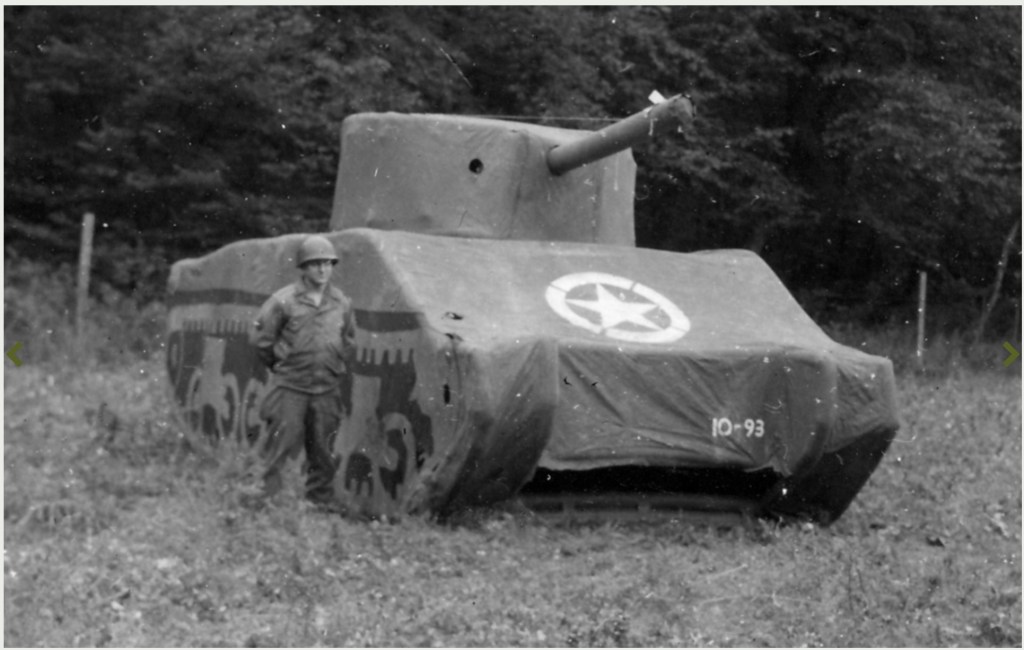
    When new recruits arrived for training, they found warehouses packed with inflatable tanks, artillery pieces, trucks, and airplanes. Hundreds of them. The men quickly learned how to inflate, position, move, and camouflage these decoys to deceive enemy reconnaissance aircraft. Imagine spending your afternoon blowing up an entire armored division with an air compressor. It sounds absurd, and more than a little comical. Yet those rubber tanks would become some of the most effective weapons in the Ghost Army’s arsenal, repeatedly fooling German intelligence and helping to save thousands of Allied lives. Sometimes, the difference between victory and defeat was nothing more than a well-placed inflatable tank.

    Dummy M4 Sherman Tank.

    The Airwaves Were a Weapon Too

    The Ghost Army didn’t rely on inflatable tanks alone. Their radio operators became masters of what they called “spoof radio,” a highly specialized form of deception designed to fool German intelligence. Because the Germans constantly monitored Allied radio traffic, Ghost Army operators carefully studied the habits, speech patterns, nicknames, and communication styles of real radio operators. When an actual combat unit moved to a new location and went silent, the Ghost Army seamlessly took over its radio identity. To German intelligence, it sounded as though the unit had never left. In many ways, they were method actors armed not with scripts and costumes, but with radios and Morse code.

    The Art of Sonic Deception

    Then there was the sonic deception unit. If Hollywood had existed on the battlefield, these men would have been running the sound department. Using advanced recording equipment and massive loudspeakers mounted on half-tracks, they blasted the sounds of moving tanks, marching troops, construction crews, and military convoys across the countryside. The recordings could carry for miles and convinced German forces that large formations were on the move. Need the enemy to believe an armored division was arriving? You play the sound of tank columns rumbling down a road. Need them to think engineers were constructing a bridge across a river? There was a recording for that, too. By mixing sounds together much like a modern movie soundtrack, the unit created remarkably convincing audio illusions. The only difference was that their audience wasn’t sitting in a theater, it was the German Army.

    Selling the Performance

    The Ghost Army understood something important: successful deception was not simply about what people saw, but what they believed. To make their illusions convincing, soldiers drove through towns in trucks adorned with the insignia of the units they were impersonating, visited local cafés, and casually discussed fictitious troop movements where enemy spies might be listening. They erected signs directing traffic to military units that did not exist, maintained campfires for soldiers who were never there, and sometimes even positioned fake equipment where it could be spotted by enemy aircraft. Every detail was carefully designed to reinforce the illusion. The goal was never perfection; it was believability. If the Germans believed an armored division was present, then the Ghost Army had done its job.

    Fooling the Germans Over and Over Again

    Between Normandy and the end of World War II, the Ghost Army carried out more than twenty deception operations, but two stand out as masterpieces of military trickery. During Operation Bettembourg, they convinced German forces that a powerful American armored division occupied a vulnerable sector of the line when, in reality, the force barely existed. The deception held for nearly a week, preventing the Germans from exploiting a dangerous gap in Allied defenses. Later, during Operation Viersen, the Ghost Army staged its most ambitious performance. Although the unit numbered only about 1,100 men, they successfully convinced the Germans that roughly 30,000 Allied troops were preparing for a major crossing of the Rhine River. To sell the illusion, they deployed more than 200 inflatable tanks, dummy artillery pieces, fake trucks, fabricated radio networks, simulated bridge construction, continuous sound effects, and even a dummy airfield. It was the military equivalent of the largest stage production in Europe, and the deception successfully diverted German attention from the actual crossing site, helping pave the way for a successful Allied advance into Germany.

    The Best-Guarded Secret of the War

    After World War II ended, the members of the Ghost Army returned home and said nothing.  For decades, their missions remained classified, and many veterans were instructed not to tell friends, family members, or even their wives what they had done during the war.  To the public, the Ghost Army was little more than a figment of the imagination, a unit that seemed too extraordinary to have ever existed. Then, in the 1990s, the full story began to emerge. Americans finally began to learn about the remarkable outfit that had weaponized creativity, revealing one of the war’s most ingenious and unconventional fighting units.

    Why the Ghost Army Matters

    The Ghost Army proves that not every hero of World War II carried a rifle or drove a tank.  Sometimes they carried a paintbrush and relied on their imagination.  Artists painted illusions, radio operators impersonated entire divisions, and sound technicians convinced the enemy that armies existed where none could be found.  Through creativity, deception, and a healthy dose of theatrical flair, these men helped to save thousands of lives and played a critical role in Allied success.  For a unit best known for inflatable tanks and elaborate tricks, the Ghost Army left an indelible mark on history.

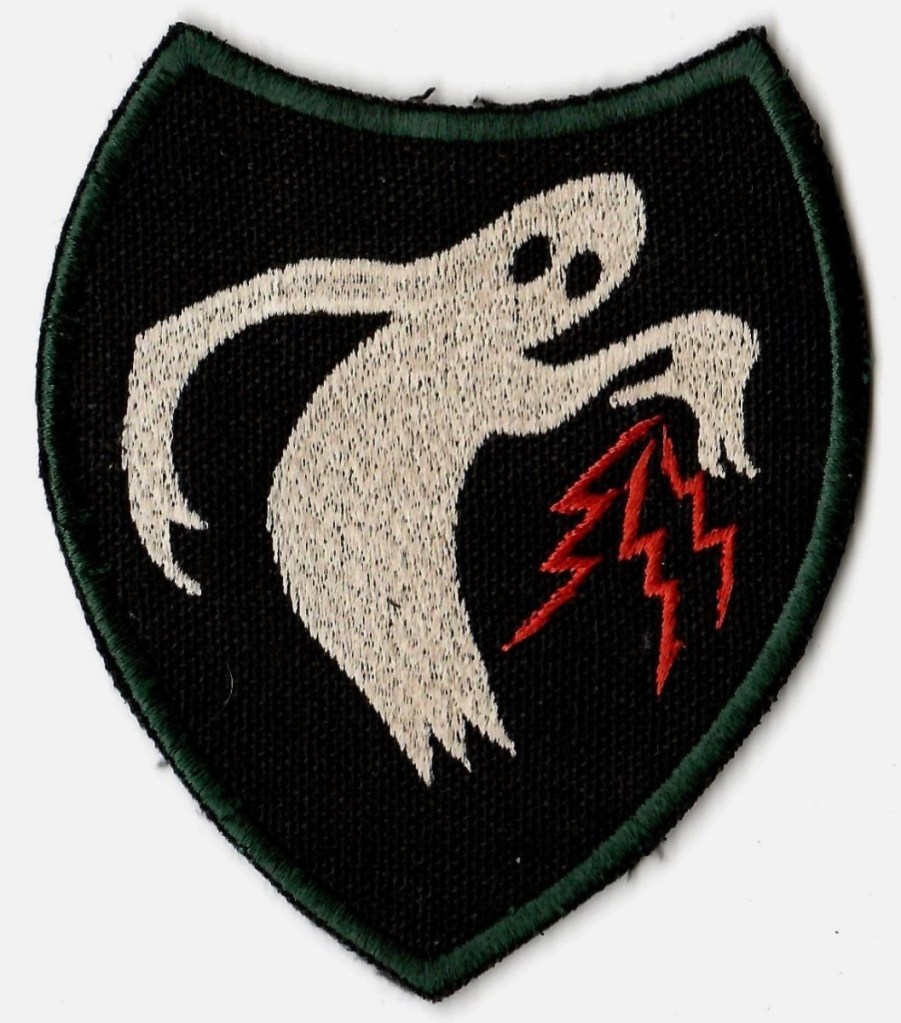
    Unofficial unit insignia.

    Bibliography

    Beyer, Rick. “Freddy Fox Goes To War”. Princeton Alumni Weekly, Last modified 2012. https://paw.princeton.edu/article/freddy-fox-goes-war.

    Beyer, Rick. The Ghost Army A Documentary Film. Film. United States: Plate of Peas Production, 2013.

    Binkovitz, Leah. “When An Army of Artists Fooled Hitler”. Smithsonian Magazine, Last modified 2013. https://www.smithsonianmag.com/history/when-an-army-of-artists-fooled-hitler-71563360/.

    Janeczko, Paul B. Secret Soldiers: How the U.S. Twenty-Third Special Troops Fooled The Nazis. Sommerville, MA: Candlewick Press, 2019.

  • In the rugged hills of northwest Alabama, far from the cotton plantations of the Black Belt, Winston County carved out a distinctive place in Civil War history.  Poor soil and steep terrain meant few large slaveholders lived there.  Most residents were yeoman farmers who saw little reason to dissolve the Union and much to lose from a war fought largely for the interests of slaveholding planters.  When Alabama seceded in January 1861, Winston’s people pushed back through a celebrated meeting that gave the county its enduring nickname, and finally by sending hundreds of men into blue uniforms.[1] Among these men was my third great-grandfather, James Alexander Barton of Company L, 1st Alabama Cavalry of the Union army.

    Winston County had been organized only a decade earlier, first as Hancock County in 1850 and renamed for Governor John A. Winston in 1855. In the 1860 presidential election most local voters backed Southern Democrat John C. Breckinridge, yet the county’s deeper loyalty was to the Union. When Alabama called a secession convention, Winston elected a 21-year-old schoolteacher named Christopher Columbus Sheats by a landslide (515-128).[2] In Montgomery, Sheats refused to sign the Ordinance of Secession after it passed (61-39). He was later expelled from the legislature and imprisoned for a time on charges of treason. His stand reflected the sentiment of many neighbors who believed secession was illegal and that the war would be fought for the interests of planters rather than hill-country farmers.

    On or about July 4, 1861, several thousand Unionists from Winston and surrounding counties gathered at Looney’s Tavern near present-day Addison. They adopted three resolutions. The first praised Sheats. The second denied Alabama’s right to leave the Union but declared that if a state could secede, then a county could secede from the state. The third asked both the Confederacy and the Union simply to leave Winston alone so its people could “Work out our own political and financial destiny.” A Confederate sympathizer present, Richard Payne, reportedly scoffed, “Oho! Winston secedes! The Free State of Winston!” The mocking phrase stuck and became a badge of local identity.[3] Winston never formally left Alabama, and the state never recognized any such claim, but the meeting announced a clear preference for neutrality that soon hardened into active Unionism.

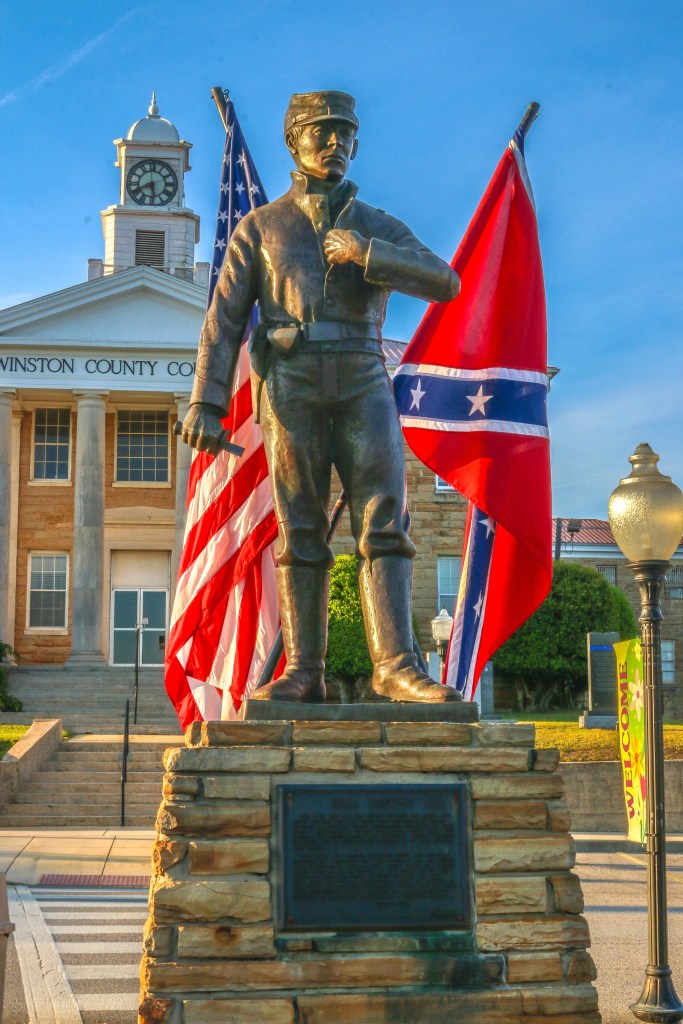
    Today the “Free State of Winston” name lives on in tourism and local memory. A weathered barn between Haleyville and Double Springs still bears the painted slogan. In front of the courthouse in Double Springs stands the Dual Destiny monument, a soldier split down the middle, half Union blue and half Confederate gray, commemorating the county’s divided loyalties. These modern emblems are not Civil War-era seals or flags; they are later expressions of a history the county has chosen to claim rather than erase.

    Neutrality proved impossible. Confederate conscription laws of 1862 sent agents into the hills. Many young men “laid out” in the forests and canyons. Natural Bridge became a known refuge for those not wanting to serve the Confederacy. Some were hunted, others threatened or had property seized. Gradually the neutral stance gave way to open resistance. Recruiters for the Union army found willing volunteers. Of the roughly 2,678 white Alabamians who enlisted in Federal service, more than 2,000 served in a single regiment: the 1st Alabama Cavalry, U.S. Volunteers, the only predominantly white Union regiment raised from Alabama.[4]

    The regiment was organized in late 1862 at Corinth, Mississippi, and Huntsville, Alabama, under Colonel George E. Spencer. Its men performed scouting, raiding, and screening duties across Northern Mississippi and Alabama. During the Atlanta Campaign of 1864 they guarded wagon trains and railroads for General Grenville Dodge’s command. When William T. Sherman prepared his March to the Sea, he deliberately chose the 1st Alabama as escort. Company I served as Sherman’s personal escort; the regiment often rode at the head of the column. The symbolism was deliberate: Southerners in blue leading the Federal army through the heart of the Confederacy. The 1st Alabama stayed with Sherman through the Carolinas Campaign, fought at Monroe’s Crossroads, and was present at the surrender of Joseph E. Johnston’s army. It mustered out in October 1865 with fewer than 400 men still on the rolls.[5]

    James Alexander Barton was one of those men. Born December 26, 1825, in Hall County, Georgia, he moved with his family into the northwest Alabama hill country. In September 1863 he and four brothers, Jonathan, Gilford, Madison, and William H., enlisted together in Company L at Glendale, Mississippi. Three brothers-in-law also joined the same company. James stood six feet one inch, with blue eyes, dark hair, and a fair complexion. He was a blacksmith by trade.  On or about October 1863, at Vincent’s Cross Roads, Mississippi, he was wounded across the back of the right hand. The injury stiffened two fingers and permanently reduced his ability to work. After the war he received a disability pension and filed a successful claim with the Southern Claims Commission for wartime losses. He later moved to Itawamba County, Mississippi, where he died April 6, 1914, at the age of 88. His gravestone simply records, “Co. L, 1 Ala. Cav.”[6]

    James’s story is typical of the regiment’s ranks: small farmers and craftsmen from the same tight-knit hill communities who chose the Union over neighbors, sometimes over blood kin. William H. Barton was captured and died at Andersonville.[7] The survivors returned to a country still marked by bitterness. Postwar violence between former Unionists and Confederates was real, yet Winston’s Unionist majority helped make the county a Republican stronghold for decades.

    The Free State of Winston was never a formal republic with its own constitution or army. It was a declaration of independence of mind, an assertion that ordinary people in the hills retained the right to decide their own loyalty. The men who rode with the 1st Alabama Cavalry translated that declaration into action, escorting Sherman’s columns and helping to break the Confederacy’s grip on the Deep South. For descendants like me, the name James A. Barton on the regimental rolls is more than a genealogical footnote. It is a reminder that the Civil War in Alabama was never a simple story of solid South versus solid North. In Winston County the choice was made one farm, one tavern meeting, and one enlistment paper at a time.

    Statue outside of Winston County Courthouse.

    [1] Christopher M. Reali, The Free State of Winston: Resistance, Refuge, and the Identity in the Civil War South (Macon, GA: Mercer University Press, 2014), 1-15.

    [2] Reali, Free State of Winston, 22-30.

    [3] Bill Lamar and Weldon Estes, Free State of Winston: The Republic of Winston and the Civil War (Double Springs, AL: Winston County Self-Historical Commission, rev. ed.), 25-39.

    [4] Reali, Free State of Winston, 63-102.

    [5] Joseph W. Overall, The 1st Alabama Cavalry, U.S.A.: Horsemen Against the Confederacy (Kent, OH: Kent State University Press, 1999), 15-43.

    [6] Overall, 1st Alabama Cavalry, 105-147; Compiled Military Service Record, James A. Barton, Company L, 1stAlabama Cavalry (US), Fold3.

    [7] Compiled Military Service Record, William H. Barton, Company L, 1st Alabama Cavalry (US), Fold3.

  • Holy Hiccups! A Genealogical Mix Up!

    Tracing the life and death of Joseph Downey, my husband’s 5th great‑grandfather, is like following a trail of history that winds through battlefields, barracks, and monuments. Joseph lived in South Carolina [according to the family tree on Ancestory.com] with his wife and children when at some point in his family life he enlisted in the U.S. Army to serve his country. There is large time gap of information due to lack of documentation until his death. Private Downey was sent to Florida with the 3rd Infantry to deal with the ever present danger of the Seminole Indians, who were in a land dispute with the government causing what at the time was known as the Florida Wars. The 3rd infantry was stationed all over Florida fighting to prevent the remaining Seminoles from returning north of the Peace River line. After his death in 1843; [His actual cause of death has been rumored to be killed in an ambush during the lingering conflicts of the Second Seminole War or disease; which took 60% of all men buried in St. Augustine.]. Joseph was first buried at Jefferson Barracks in Missouri. At that time, it was standard practice: soldiers who fought in the West or in Indian wars were laid to rest there, far from the Florida swamps where they fell.

    Here is the hiccup…

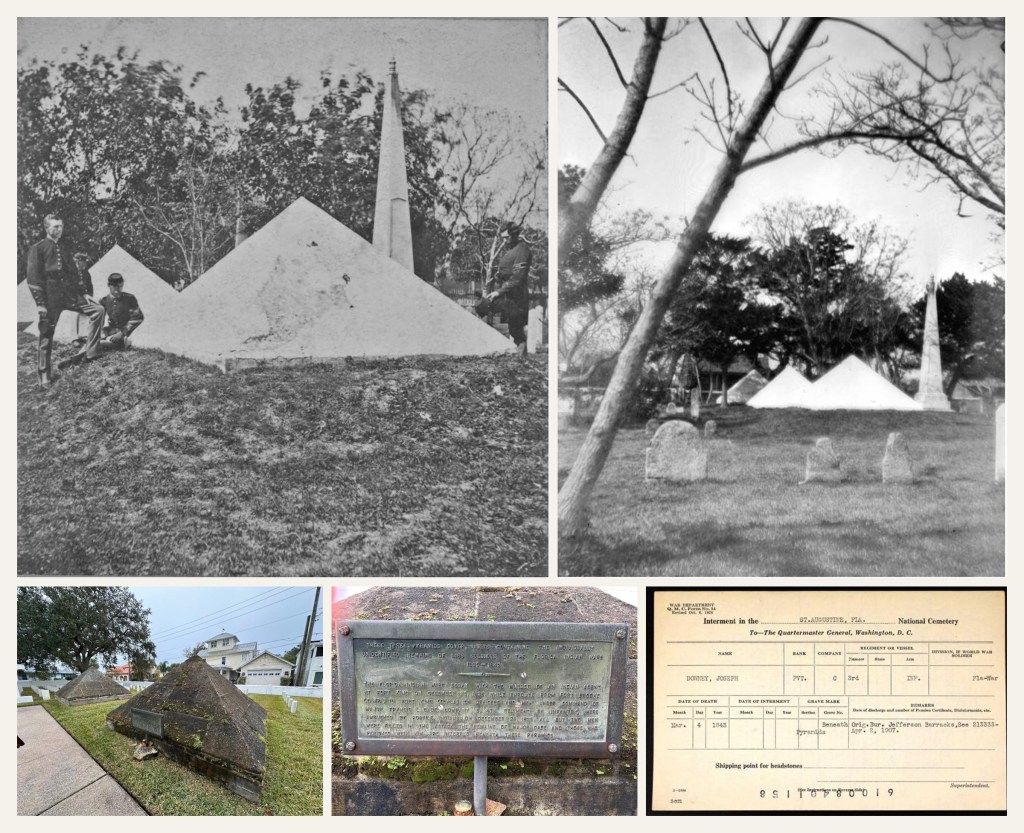
    History however did not leave Private Joseph Downey there. In the late 19th century, the U.S. Army began consolidating smaller cemeteries, deciding that all Seminole War dead should be reinterred in St. Augustine. By 1907, Joseph’s remains were removed from his marked grave site and shipped back to Florida where he joined 1,468 other soldiers beneath three coquina pyramids in the National Cemetery. These pyramids were not organized by individual names but as collective memorials. The first pyramid, nearest an ostentatious marble obelisk, held the remains of Major Dade’s men from the infamous 1835 massacre, along with other soldiers whose graves were loosely marked from the battles. As additional remains were gathered from scattered skirmishes, the second and third pyramids were filled, with the final reinterments being completed in 1907.

    Today, Joseph Downey rests not in an individual grave but as part of a collective shrine to sacrifice. His name survives in very few records, but his physical burial is anonymous; absorbed into a monument that symbolizes both the cost of war and the way history remembers its fallen.

    The story ends very quietly as I watched my husband walking around the three pyramids trying to figure out which one contained his Great Grandfather’s remains, which one he was to connect to, leave his rock by to say he had a visitor today… But alas the only record of Grandpa Joseph now is a paper list found in a box near the Inspector General’s office in the cemetery that states he is in fact buried in the pyramids, but that the overall list to each contains “Unknown Soldiers.”

    So I close this blog with a question to ponder: Why would the United States military remove a soldier from a marked grave where family can trace him hundreds of years after the Seminole wars, only to place him in a collective monument where his identity and all others are listed as “unknown”?

    Sources:

    • Explore Southern History. “The Dade Pyramids – St. Augustine, Florida.” Accessed December 7, 2025. https://exploresouthernhistory.com/dadepyramids.html..
    • National Archives and Records Administration. Record Group 92, Records of the Office of the Quartermaster General. Consolidated Correspondence File, 1794–1915, Box 1045, “Seminole War Remains – Disinterment and Reburial 1906–1909. Entry for Joseph Downey (File 213533) lists cause of death as “disease” (not KIA).
    • The Historical Marker Database. “Dade Pyramids.” Last updated September 28, 2016. https://www.hmdb.org/m.asp?m=77411..
    • U.S. Department of Veterans Affairs. “Dade Pyramids.” VA History: 100 Objects. Accessed December 7, 2025. https://department.va.gov/history/100-objects/071-dade-pyramids/..
  • The American Revolution was fought with muskets, cannon, and courage. But none of those things came cheaply.  When the Continental Congress took up arms against Great Britain in 1775, it faced a problem almost as dangerous as the British Army itself: there was no money. The colonies had no national treasury, no federal tax system, and no common currency. Congress could request funds from the states, but it had no authority to compel payment.

    Yet somehow the Revolution survived eight long years of war.  America’s leaders financed independence through a combination of paper money, foreign loans, state contributions, and even the personal credit of wealthy patriots. Some of these measures proved effective. Others were financial disasters. Together, they exposed the weaknesses of the government under the Articles of Confederation and helped shape the stronger federal system that emerged with the Constitution.

    The story of how America paid for its Revolution is more than an economic footnote. It is the story of a nation learning, often painfully, what it took to survive.

    Printing Prosperity? The Continental Dollar Experiment

    Congress’s first solution was the quickest and easiest one: print money.  Beginning in 1775, Congress issued Continental Dollars to finance the war effort. The bills were backed largely by a promise that the states would eventually raise taxes and redeem them. Early Americans accepted the currency because they believed independence would be won and the debts would ultimately be paid.

    At first, the system seemed workable.  The problem was that Congress had no reliable way to remove money from circulation. As military expenses mounted, more and more bills rolled off the printing presses. By late 1779, roughly $200 million in new paper currency had entered circulation. Confidence began to collapse.

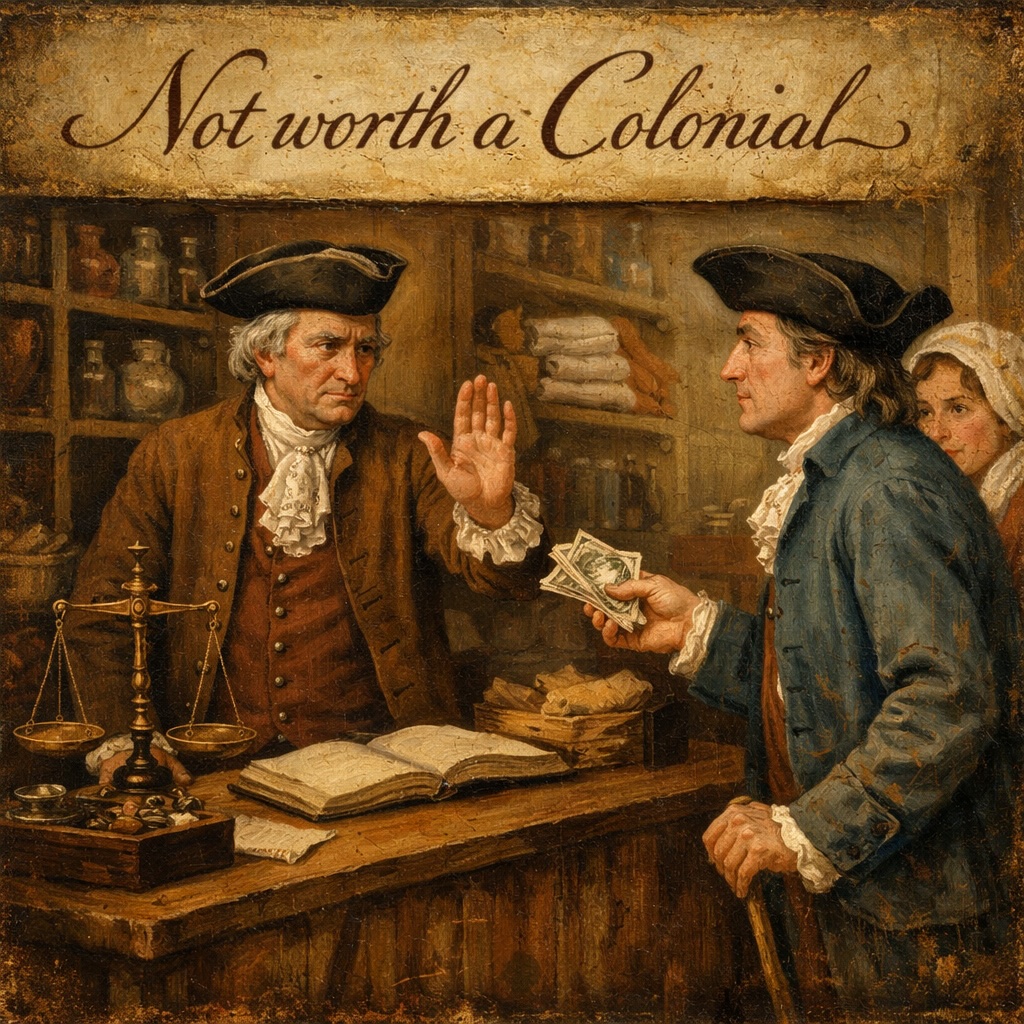
    Prices skyrocketed. Goods that cost one dollar in 1775 might cost forty dollars only a few years later. The depreciation became so severe that Americans coined a new expression for something worthless: “not worth a Continental.”

    To be fair, printing money gave Congress resources when few other options existed. Some historians have argued that the Continental Dollar represented an early effort to create national financial authority. But whatever its political significance, its economic performance was disastrous. Without sufficient taxation or a credible redemption plan, the currency could not maintain its value.  The result was a lesson Americans would not soon forget money requires trust, and trust cannot be printed.

    Artist’s illustration of a merchant declining Continental currency, reflecting the rapid depreciation of Continental dollars in the late 1770s.

    The Dollar’s Unexpected Origin

    Ironically, one of the Revolution’s most enduring financial achievements emerged from the chaos created by its failing currency.  In 1782, Superintendent of Finance Robert Morris proposed that the United States adopt the dollar as its standard monetary unit. His recommendation addressed a practical problem familiar to every merchant in America.

    The young nation was flooded with foreign coins. English shillings, French livres, Portuguese Johannes, and Spanish dollars circulated side by side. Worse, their values often varied from state to state. Merchants conducting business across state lines faced constant confusion.  Morris recognized that one coin already enjoyed widespread acceptance: the Spanish dollar, often called the “piece of eight.” Farmers, shopkeepers, soldiers, and traders understood its value and used it regularly.

    Rather than create an entirely new system, Morris proposed building upon what Americans already trusted. He also recommended a decimal structure based on dollars and cents, creating a monetary framework far simpler than the complex systems used in Europe.  More than two centuries later, Americans still carry currency built upon Morris’s basic idea.

    France Saves the Revolution

    If paper money was the Revolution’s greatest financial weakness, foreign assistance was its greatest strength.  By 1778, the war had become an international conflict. France formally allied itself with the United States and committed vast resources to the American cause. French support included military aid, supplies, subsidies, and loans worth millions of dollars.

    Benjamin Franklin played a crucial role in securing that assistance. While serving in Paris, he transformed American victories and political goodwill into desperately needed hard currency. French money helped feed soldiers, purchase supplies, and sustain military operations when Congress could not meet its obligations on its own.

    Spain also contributed aid, financing portions of the war effort and supporting operations that culminated in the Yorktown campaign. In 1782, John Adams secured substantial loans from Dutch financiers, further strengthening America’s position.

    Unlike Continental currency, foreign loans held their value. They allowed Congress to obtain real resources rather than promises. Historians continue to debate the long-term implications of this borrowing, but one reality is difficult to escape: without European money, the Revolution might not have survived.  The irony was unmistakable. The nation fighting for independence depended heavily upon foreign creditors to win it.

    When Congress Ran Out of Money

    Foreign aid helped, but it did not solve every problem.  Under the Articles of Confederation, Congress relied heavily on requisitions from the states. Each state was assigned a share of national expenses and asked to contribute accordingly. In practice, however, many states paid only a portion of what was requested.

    Congress soon found itself trapped. It had responsibilities but little authority. It could call for money but could not effectively collect it.  As shortages grew, the army increasingly relied on impressment, the forced acquisition of supplies from civilians. Not surprisingly, this did little to boost public morale.

    Into this crisis stepped Robert Morris.  Appointed Superintendent of Finance in 1781, Morris brought both organizational skill and personal credibility to the nation’s finances. Drawing upon his extensive merchant network, he advanced approximately $1.4 million during the Yorktown campaign. Notes backed largely by his reputation circulated when government credit alone was insufficient.

    George Washington worked closely with Morris during this period, understanding that military success depended as much on financing as on battlefield tactics.  Morris helped stabilize a failing system, but his efforts revealed a troubling reality. The United States could not rely indefinitely on the wealth and reputation of individual patriots. Temporary solutions might win a war, but they could not sustain a nation.

    A Crisis That Created the Constitution

    The financial struggles of the Revolution raised a question that Americans would continue debating for generations: were the Founders reckless improvisers or visionary nation-builders?  In truth, they were a little of both.  Congress employed every tool available. It printed money, sought foreign loans, requested state contributions, established loan offices, and relied upon private credit. Some of these measures succeeded. Others failed spectacularly.

    Yet the failures proved just as important as the successes.  The collapse of the Continental Dollar demonstrated the dangers of issuing currency without adequate financial backing. The state’s inconsistent support revealed the limitations of a government that could not effectively raise revenue. Dependence on foreign lenders highlighted the importance of establishing national credit.

    The Constitution addressed each of these weaknesses directly.  Unlike the Articles of Confederation, the new framework granted Congress the power to tax, borrow money, regulate currency, and pay the nation’s debts. The financial chaos of the Revolution convinced many Americans that independence required more than political freedom. It required institutions capable of supporting it.  In that sense, the Revolution did not merely create a new nation. It created a new understanding of government itself.

    Why It Still Matters

    The Revolution was not financed through a single brilliant solution. It survived through a patchwork of desperate measures.  Paper money provided quick cash but eventually collapsed under the weight of inflation. State requisitions rarely met expectations. Robert Morris’s personal credit helped bridge dangerous shortages but could not serve as a permanent solution. In the end, foreign loans, especially French aid, provided the strongest financial lifeline of the war.

    Those struggles left a lasting mark on the United States.  The dollar in your wallet traces its origins to the wartime efforts of Robert Morris. The federal government’s authority to tax and borrow emerged directly from the failures of the Articles of Confederation. Even America’s enduring concern with public debt and fiscal responsibility can be traced back to the Revolution’s financial hardships.

    America won its independence on the battlefield. But it secured its future in the treasury, the countinghouse, and the halls of Congress.  The next time you spend a dollar, remember that it began as part of a desperate effort to finance a revolution that nearly ran out of money before it won its freedom.

    Sources

    Farley Grubb, The Continental Dollar: How the American Revolution was Financed with Paper Money (University of Chicago Press, 2023).

    Charles Rappleye, Robert Morris: Financier of the American Revolution (Simon & Schuster, 2010).

    E. James Ferguson, The Power of the Purse: A History of American Public Finance, 1776-1790 (University of North Carolina Press, 1961).

  • The People Who Make History

    History is often told through the names of rulers, battles, and great turning points. But ordinary people also shape the past: through the choices they make, the lives they build, and the courage or kindness they show one another. Their stories can reveal how history touches everyday life, and how everyday life can change history.

    At All in on History, we’ll explore these connections and ask what virtues can transform in people and in the world around them. Come along to look at familiar events from fresh angles, discover the lives behind the headlines, and consider what the past might ask of us today.

    We are excited to welcome you to All in on History and to share the first update on one of our largest archival projects to date. Over the past 20 months, we have been working to preserve and make accessible a collection of approximately 480 historical letters. The first major phase of the project, digitization, is now largely complete. Each letter has been carefully scanned to create high-quality digital images, with occasional rescanning performed when image quality did not meet our standards.

    The next phase of the project is transcription. To accelerate the process, we utilized artificial intelligence to generate initial draft transcripts for each letter. While AI can be a valuable tool for reading historical handwriting, it is far from perfect. Every transcript must now undergo a line-by-line, word-by-word review by a human editor to verify accuracy and correct any errors.

    Historical documents present unique challenges. Faded ink, unfamiliar handwriting styles, damaged pages, and obsolete spellings can all lead to transcription mistakes. Because of this, no AI-generated transcript will be published without human verification.

    After the initial review is completed, each transcript will undergo a second independent review. This additional layer of quality control helps ensure that the final transcription reflects the original document as accurately as possible.

    Our goal is not simply to create searchable text, but to produce a reliable and trustworthy resource for researchers, genealogists, historians, and family members interested in the stories preserved within these letters.

    As this work progresses, we will share updates about the collection, highlight interesting discoveries, and provide a behind-the-scenes look at the challenges and rewards of archival preservation.

    Thank you for joining us at the beginning of this journey. We look forward to sharing these historical voices with you in the months and years ahead.

    The past matters. Let’s preserve it together.