
Tracing the life and death of Joseph Downey, my husband’s 5th great‑grandfather, is like following a trail of history that winds through battlefields, barracks, and monuments. Joseph lived in South Carolina [according to the family tree on Ancestory.com] with his wife and children when at some point in his family life he enlisted in the U.S. Army to serve his country. There is large time gap of information due to lack of documentation until his death. Private Downey was sent to Florida with the 3rd Infantry to deal with the ever present danger of the Seminole Indians, who were in a land dispute with the government causing what at the time was known as the Florida Wars. The 3rd infantry was stationed all over Florida fighting to prevent the remaining Seminoles from returning north of the Peace River line. After his death in 1843; [His actual cause of death has been rumored to be killed in an ambush during the lingering conflicts of the Second Seminole War or disease; which took 60% of all men buried in St. Augustine.]. Joseph was first buried at Jefferson Barracks in Missouri. At that time, it was standard practice: soldiers who fought in the West or in Indian wars were laid to rest there, far from the Florida swamps where they fell.
Here is the hiccup…
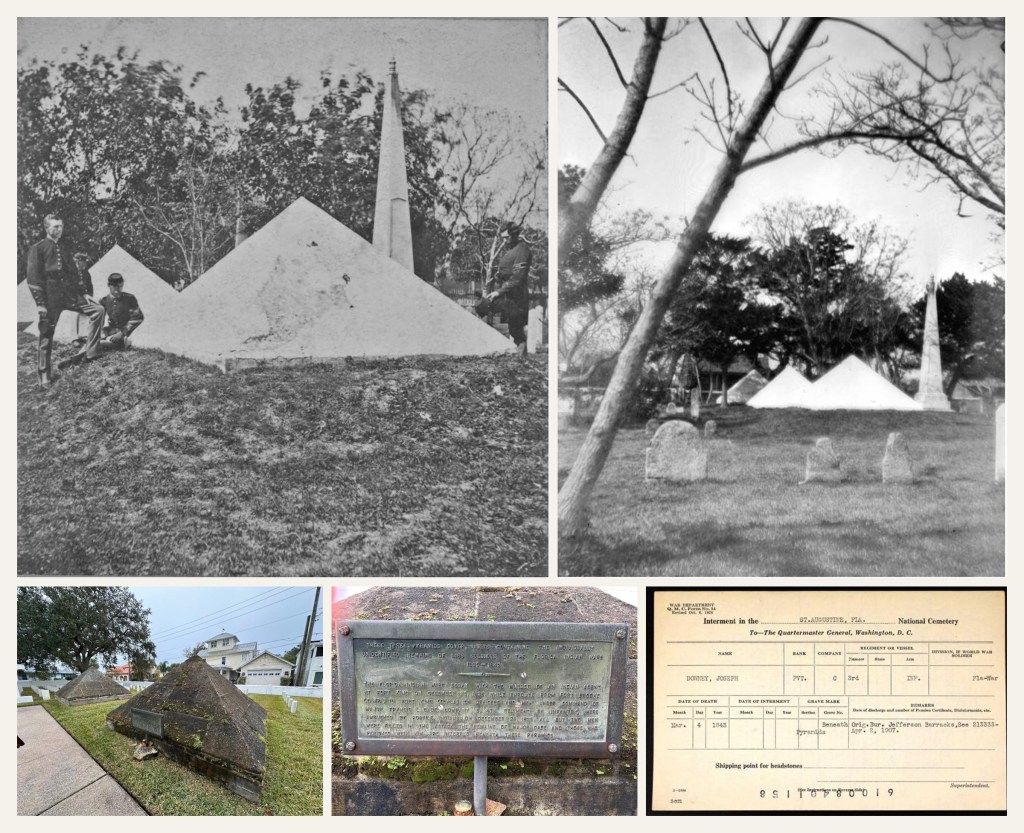
History however did not leave Private Joseph Downey there. In the late 19th century, the U.S. Army began consolidating smaller cemeteries, deciding that all Seminole War dead should be reinterred in St. Augustine. By 1907, Joseph’s remains were removed from his marked grave site and shipped back to Florida where he joined 1,468 other soldiers beneath three coquina pyramids in the National Cemetery. These pyramids were not organized by individual names but as collective memorials. The first pyramid, nearest an ostentatious marble obelisk, held the remains of Major Dade’s men from the infamous 1835 massacre, along with other soldiers whose graves were loosely marked from the battles. As additional remains were gathered from scattered skirmishes, the second and third pyramids were filled, with the final reinterments being completed in 1907.
Today, Joseph Downey rests not in an individual grave but as part of a collective shrine to sacrifice. His name survives in very few records, but his physical burial is anonymous; absorbed into a monument that symbolizes both the cost of war and the way history remembers its fallen.
The story ends very quietly as I watched my husband walking around the three pyramids trying to figure out which one contained his Great Grandfather’s remains, which one he was to connect to, leave his rock by to say he had a visitor today… But alas the only record of Grandpa Joseph now is a paper list found in a box near the Inspector General’s office in the cemetery that states he is in fact buried in the pyramids, but that the overall list to each contains “Unknown Soldiers.”
So I close this blog with a question to ponder: Why would the United States military remove a soldier from a marked grave where family can trace him hundreds of years after the Seminole wars, only to place him in a collective monument where his identity and all others are listed as “unknown”?
Sources:
- Explore Southern History. “The Dade Pyramids – St. Augustine, Florida.” Accessed December 7, 2025. https://exploresouthernhistory.com/dadepyramids.html..
- National Archives and Records Administration. Record Group 92, Records of the Office of the Quartermaster General. Consolidated Correspondence File, 1794–1915, Box 1045, “Seminole War Remains – Disinterment and Reburial 1906–1909. Entry for Joseph Downey (File 213533) lists cause of death as “disease” (not KIA).
- The Historical Marker Database. “Dade Pyramids.” Last updated September 28, 2016. https://www.hmdb.org/m.asp?m=77411..
- U.S. Department of Veterans Affairs. “Dade Pyramids.” VA History: 100 Objects. Accessed December 7, 2025. https://department.va.gov/history/100-objects/071-dade-pyramids/..


Leave a Reply