
The American Revolution was fought with muskets, cannon, and courage. But none of those things came cheaply. When the Continental Congress took up arms against Great Britain in 1775, it faced a problem almost as dangerous as the British Army itself: there was no money. The colonies had no national treasury, no federal tax system, and no common currency. Congress could request funds from the states, but it had no authority to compel payment.
Yet somehow the Revolution survived eight long years of war. America’s leaders financed independence through a combination of paper money, foreign loans, state contributions, and even the personal credit of wealthy patriots. Some of these measures proved effective. Others were financial disasters. Together, they exposed the weaknesses of the government under the Articles of Confederation and helped shape the stronger federal system that emerged with the Constitution.
The story of how America paid for its Revolution is more than an economic footnote. It is the story of a nation learning, often painfully, what it took to survive.
Printing Prosperity? The Continental Dollar Experiment
Congress’s first solution was the quickest and easiest one: print money. Beginning in 1775, Congress issued Continental Dollars to finance the war effort. The bills were backed largely by a promise that the states would eventually raise taxes and redeem them. Early Americans accepted the currency because they believed independence would be won and the debts would ultimately be paid.
At first, the system seemed workable. The problem was that Congress had no reliable way to remove money from circulation. As military expenses mounted, more and more bills rolled off the printing presses. By late 1779, roughly $200 million in new paper currency had entered circulation. Confidence began to collapse.
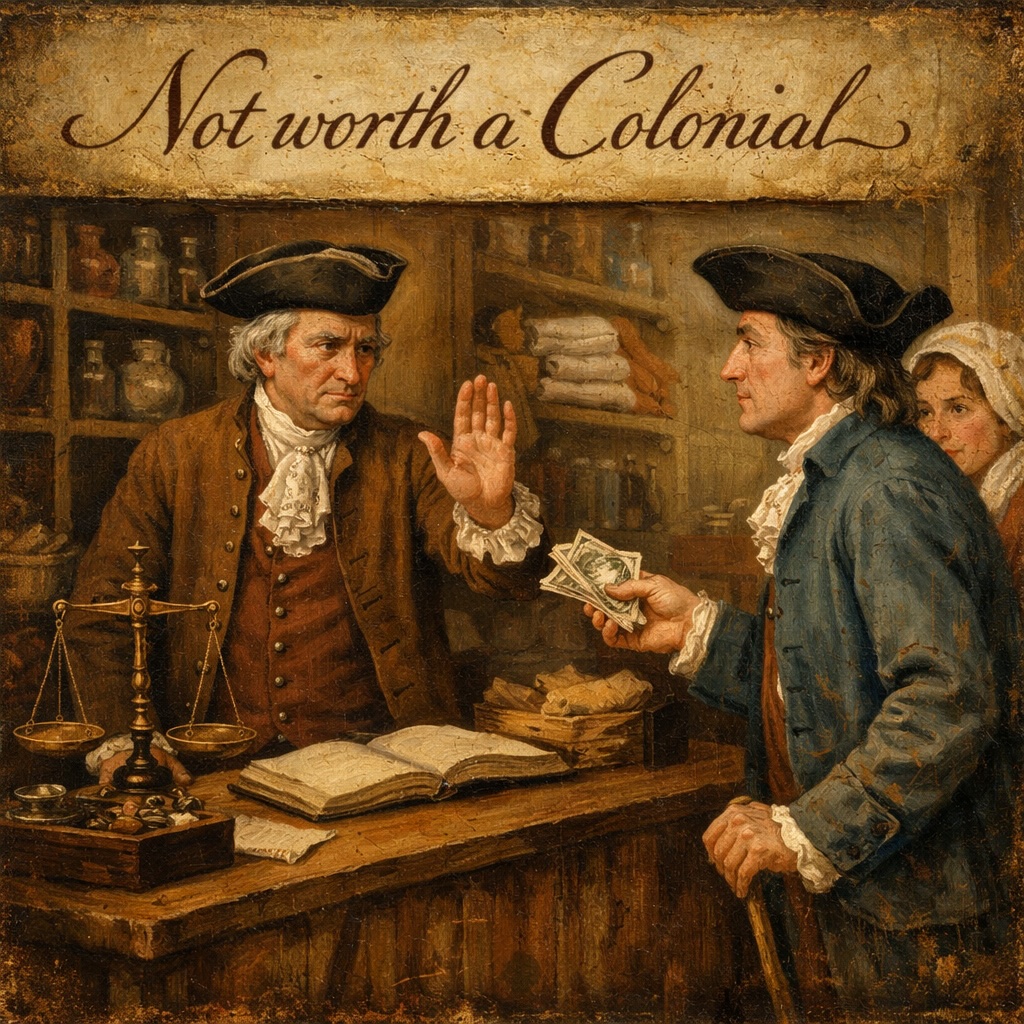
Prices skyrocketed. Goods that cost one dollar in 1775 might cost forty dollars only a few years later. The depreciation became so severe that Americans coined a new expression for something worthless: “not worth a Continental.”
To be fair, printing money gave Congress resources when few other options existed. Some historians have argued that the Continental Dollar represented an early effort to create national financial authority. But whatever its political significance, its economic performance was disastrous. Without sufficient taxation or a credible redemption plan, the currency could not maintain its value. The result was a lesson Americans would not soon forget money requires trust, and trust cannot be printed.
The Dollar’s Unexpected Origin
Ironically, one of the Revolution’s most enduring financial achievements emerged from the chaos created by its failing currency. In 1782, Superintendent of Finance Robert Morris proposed that the United States adopt the dollar as its standard monetary unit. His recommendation addressed a practical problem familiar to every merchant in America.
The young nation was flooded with foreign coins. English shillings, French livres, Portuguese Johannes, and Spanish dollars circulated side by side. Worse, their values often varied from state to state. Merchants conducting business across state lines faced constant confusion. Morris recognized that one coin already enjoyed widespread acceptance: the Spanish dollar, often called the “piece of eight.” Farmers, shopkeepers, soldiers, and traders understood its value and used it regularly.
Rather than create an entirely new system, Morris proposed building upon what Americans already trusted. He also recommended a decimal structure based on dollars and cents, creating a monetary framework far simpler than the complex systems used in Europe. More than two centuries later, Americans still carry currency built upon Morris’s basic idea.
France Saves the Revolution
If paper money was the Revolution’s greatest financial weakness, foreign assistance was its greatest strength. By 1778, the war had become an international conflict. France formally allied itself with the United States and committed vast resources to the American cause. French support included military aid, supplies, subsidies, and loans worth millions of dollars.
Benjamin Franklin played a crucial role in securing that assistance. While serving in Paris, he transformed American victories and political goodwill into desperately needed hard currency. French money helped feed soldiers, purchase supplies, and sustain military operations when Congress could not meet its obligations on its own.
Spain also contributed aid, financing portions of the war effort and supporting operations that culminated in the Yorktown campaign. In 1782, John Adams secured substantial loans from Dutch financiers, further strengthening America’s position.
Unlike Continental currency, foreign loans held their value. They allowed Congress to obtain real resources rather than promises. Historians continue to debate the long-term implications of this borrowing, but one reality is difficult to escape: without European money, the Revolution might not have survived. The irony was unmistakable. The nation fighting for independence depended heavily upon foreign creditors to win it.
When Congress Ran Out of Money
Foreign aid helped, but it did not solve every problem. Under the Articles of Confederation, Congress relied heavily on requisitions from the states. Each state was assigned a share of national expenses and asked to contribute accordingly. In practice, however, many states paid only a portion of what was requested.
Congress soon found itself trapped. It had responsibilities but little authority. It could call for money but could not effectively collect it. As shortages grew, the army increasingly relied on impressment, the forced acquisition of supplies from civilians. Not surprisingly, this did little to boost public morale.
Into this crisis stepped Robert Morris. Appointed Superintendent of Finance in 1781, Morris brought both organizational skill and personal credibility to the nation’s finances. Drawing upon his extensive merchant network, he advanced approximately $1.4 million during the Yorktown campaign. Notes backed largely by his reputation circulated when government credit alone was insufficient.
George Washington worked closely with Morris during this period, understanding that military success depended as much on financing as on battlefield tactics. Morris helped stabilize a failing system, but his efforts revealed a troubling reality. The United States could not rely indefinitely on the wealth and reputation of individual patriots. Temporary solutions might win a war, but they could not sustain a nation.
A Crisis That Created the Constitution
The financial struggles of the Revolution raised a question that Americans would continue debating for generations: were the Founders reckless improvisers or visionary nation-builders? In truth, they were a little of both. Congress employed every tool available. It printed money, sought foreign loans, requested state contributions, established loan offices, and relied upon private credit. Some of these measures succeeded. Others failed spectacularly.
Yet the failures proved just as important as the successes. The collapse of the Continental Dollar demonstrated the dangers of issuing currency without adequate financial backing. The state’s inconsistent support revealed the limitations of a government that could not effectively raise revenue. Dependence on foreign lenders highlighted the importance of establishing national credit.
The Constitution addressed each of these weaknesses directly. Unlike the Articles of Confederation, the new framework granted Congress the power to tax, borrow money, regulate currency, and pay the nation’s debts. The financial chaos of the Revolution convinced many Americans that independence required more than political freedom. It required institutions capable of supporting it. In that sense, the Revolution did not merely create a new nation. It created a new understanding of government itself.
Why It Still Matters
The Revolution was not financed through a single brilliant solution. It survived through a patchwork of desperate measures. Paper money provided quick cash but eventually collapsed under the weight of inflation. State requisitions rarely met expectations. Robert Morris’s personal credit helped bridge dangerous shortages but could not serve as a permanent solution. In the end, foreign loans, especially French aid, provided the strongest financial lifeline of the war.
Those struggles left a lasting mark on the United States. The dollar in your wallet traces its origins to the wartime efforts of Robert Morris. The federal government’s authority to tax and borrow emerged directly from the failures of the Articles of Confederation. Even America’s enduring concern with public debt and fiscal responsibility can be traced back to the Revolution’s financial hardships.
America won its independence on the battlefield. But it secured its future in the treasury, the countinghouse, and the halls of Congress. The next time you spend a dollar, remember that it began as part of a desperate effort to finance a revolution that nearly ran out of money before it won its freedom.
Sources
Farley Grubb, The Continental Dollar: How the American Revolution was Financed with Paper Money (University of Chicago Press, 2023).
Charles Rappleye, Robert Morris: Financier of the American Revolution (Simon & Schuster, 2010).
E. James Ferguson, The Power of the Purse: A History of American Public Finance, 1776-1790 (University of North Carolina Press, 1961).


Leave a Reply